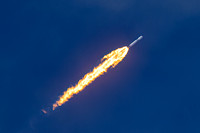
On Tuesday, June 25 at 5:26 p.m. ET, Falcon Heavy launched the National Oceanic and Atmospheric Administration's (NOAA) GOES-U mission to a geostationary orbit from Launch Complex 39A (LC-39A) at NASA's Kennedy Space Center in Florida.
The GOES-U satellite will orbit above the Earth's equator at approximately 35,700 km (22,236 mi) observing weather patterns in the contiguous USA, Central and South America, and Atlantic Ocean. GOES-U is part of NOAA's most sophisticated Geostationary Operational Environmental Satellites (GOES) series and will assist weather forecasters and climate researchers with real-time high-resolution imagery, earlier detection of severe weather that could save lives, and tropical cyclone forecasts. The weather satellite also carries a suite of space weather instruments that will be used to detect solar storms early and help predict their possible impacts.
This was the first launch for Falcon Heavy’s two side boosters. Following booster separation, the boosters successfully landed on SpaceX’s Landing Zones 1 and 2 (LZ-1 and LZ-2) at Cape Canaveral Space Force Station in Florida. The core booster was expended in the Atlantic Ocean following separation.